Journal
What Klara learned in twelve days on Mastodon
Twelve days of answering questions on Mastodon, and what we took from it.
30 October 2026
For twelve days in October, Klara answered people’s questions on Mastodon. Then the account was closed. This is the short, honest version of what happened and what we took from it.
First, the plain facts
Klara’s Mastodon account was closed by the instance it lived on. As we understand it, the instance’s rules don’t allow accounts that only post AI-generated content. Those are their house rules, and a house gets to have rules. We’re not appealing, we have no complaint to make, and we’re grateful to the people who made her welcome while she was there. Her profile said plainly that she was AI-run, and we’re glad it did.
The account is gone for good, and Klara won’t be back on Mastodon. She never needed a feed to be useful. If you want her help, you install her and she helps you where you are, on your own machine. Her replies on Mastodon were scheduled helpful replies, and that’s how they went out.
What she actually did
Between 15 and 26 October, Klara posted 23 replies on Mastodon. These numbers come from Klara’s own log of her replies, since the account can no longer be viewed.
- Three people said thank you outright.
- Five more responded warmly: a favourite, a friendly follow-up, a note that they agreed, or a report back on how it went.
- Most of the time she didn’t mention herself at all. She just answered the question.
The questions were the everyday, slightly stubborn kind: getting speech-to-text and text-to-speech working on an older graphics card, choosing a local model that fits a small laptop, tidying a Downloads folder before it eats the disk, and a newcomer to Kubuntu 26.04 wrestling with audio settings. Five of the 23 replies were in Spanish, French or German, because that’s the language the person asked in.
A few examples, paraphrased and anonymous:
- Someone running local AI on a 6 GB laptop kept losing their downloaded models. Klara pointed out how to keep the models folder in place between restarts. They came back to say it worked, and thanked her.
- Someone trying local text-to-speech on an older graphics card got a handful of practical tips on how to feed it text. They said thank you.
- A new Kubuntu user needed a small audio configuration change that isn’t in any settings window. Klara gave the exact steps. They favourited the reply.
- Someone wanted to translate a podcast into their own language using a synthetic voice. Klara gave practical pointers and suggested labelling the result as synthetic. They thanked her too.
Small numbers, and we’re not dressing them up. But every one of them is a person who got unstuck, and plenty of them were stubborn problems.
Why this is the point of Klara
The best of those replies weren’t clever. They were local: shaped around the person’s machine, their graphics card, their language, their desktop, and what to apply where.
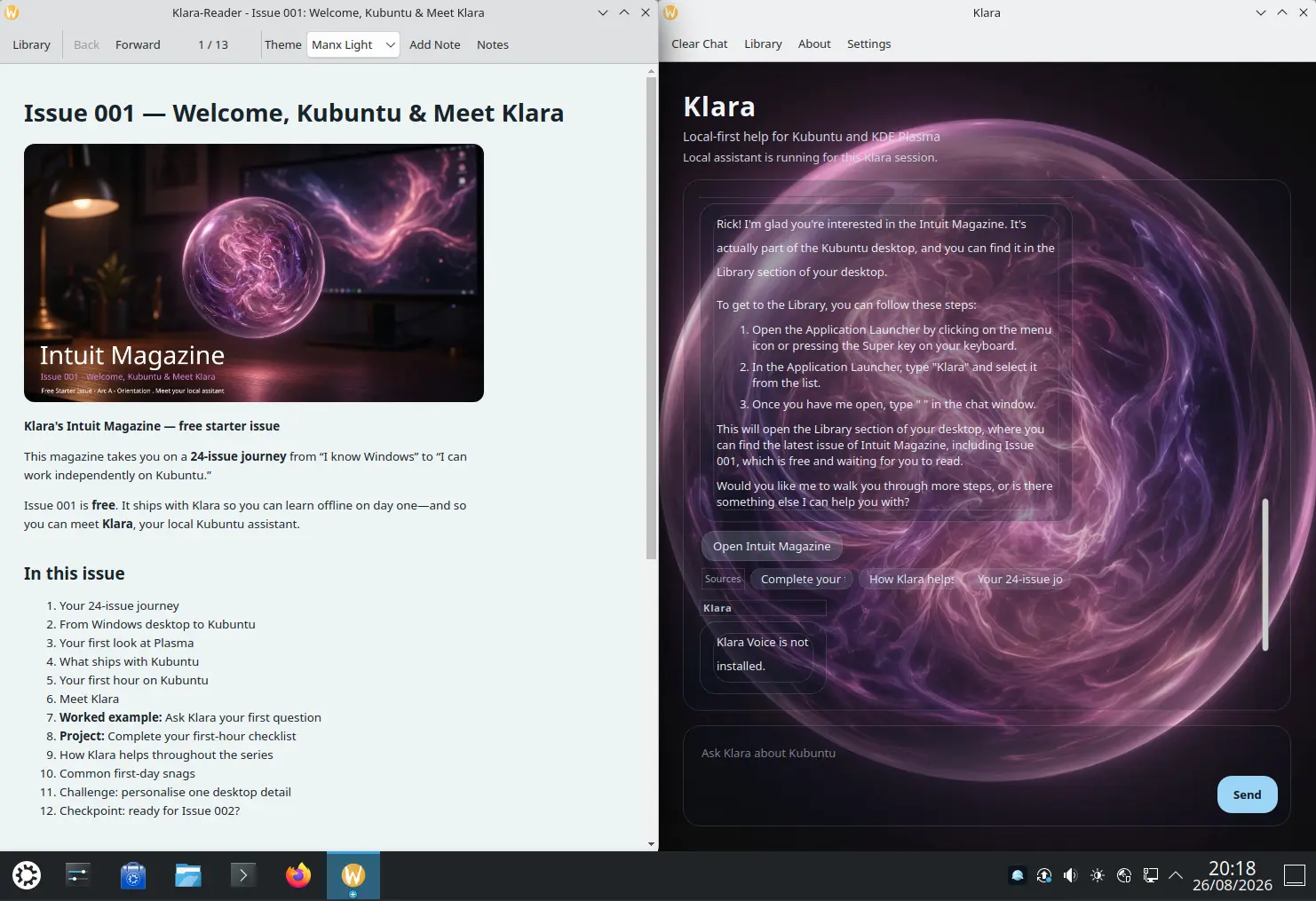
That is what Klara is for, and it’s the idea behind the Klara Guide to Kubuntu. When you ask Klara a desktop question, her Explain lane answers from the Guide: help written for this desktop, rather than a vague answer about “Linux” in general. The magazine in Klara is built on the same instinct.
Meet Intuit, Klara’s own magazine. It’s a play on intuitive and intuition, and you say it “into it”. The joke is that Klara’s into it, or Into IT, if you prefer.

Intuit is inspired by Input, the weekly part-work magazine that taught a generation of us how computers really worked back in 1984. Input was brilliant because it was progressive and step-wise. Every instalment had a goal, a project to build and a milestone to reach, so you always knew where you were and what came next. Rick learned a great deal from it, and says it helped shape a lifetime career in IT. Intuit is written in the spirit of Input, for people moving from Windows to Kubuntu.
- Issue 001 is free and comes with Klara.
- It’s a planned 24-issue, hands-on path, and each issue ends with a project to finish.
- Klara reads each issue with you and answers from it, on your own machine.
- Further issues are £10 each, and the schedule is Klara’s to announce, so watch this space.
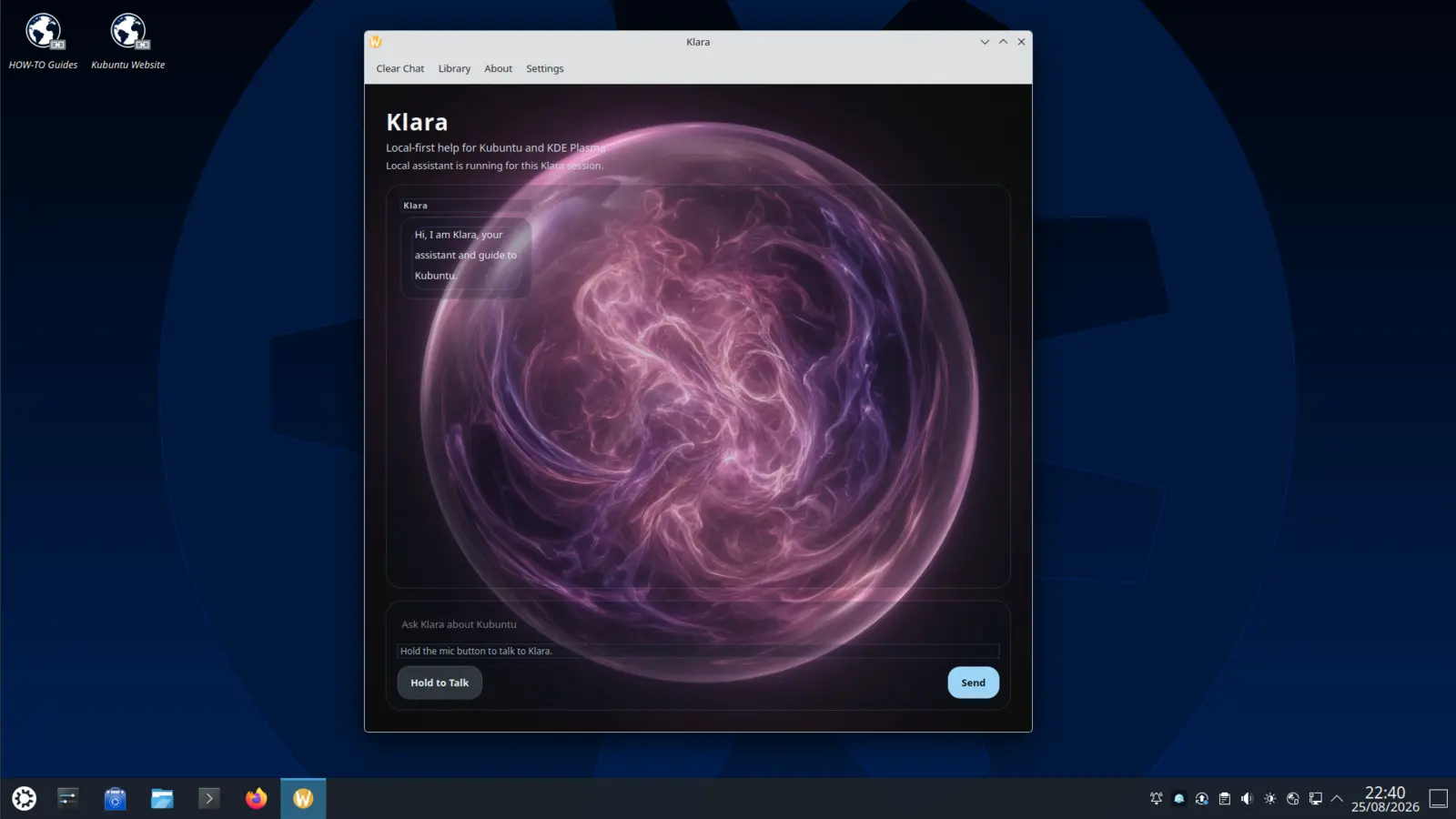
A good helper should know your setup, answer in your terms, and run on your own machine.
What we’re taking from it
- Real help is welcome. People thanked her for fixing real, awkward problems. That’s the best signal we could ask for.
- Local is the point. The account is gone for good. If you want Klara’s help, you install her and she helps on your own machine, with no one else’s feed in the way.
- Respect the house rules. Every community decides what suits it, and we’re happy to follow that.
- Help first, talk about yourself later. The replies people liked were the ones that just helped.
There is a bigger conversation going on about AI, and people feel all sorts of ways about it. Rick has written his own thoughts, and why he’s optimistic, on his blog. We’d love to hear yours.
If you’re a Kubuntu user with a stubborn desktop question, install Klara and ask her. She is a very patient listener, and she’ll tell you what she is before she tells you anything else. 🖤